

Daily wear
Recommended
22 hrs
hours per day
Minimum
20 hrs
hours per day
Doctor-guided clear aligners
TruAligner clear aligners help you achieve your best smile and a healthy, well-protected bite—using advanced technology and treatment guided by the doctor who knows you best.

What you get
Who plans your treatment, what arrives, and how you follow it.
A licensed dentist reviews your case and directs the plan from start to finish.
Every aligner in your plan, made to the shape of your own teeth.
Check how your smile is moving as you work through the trays.
Your patient portal
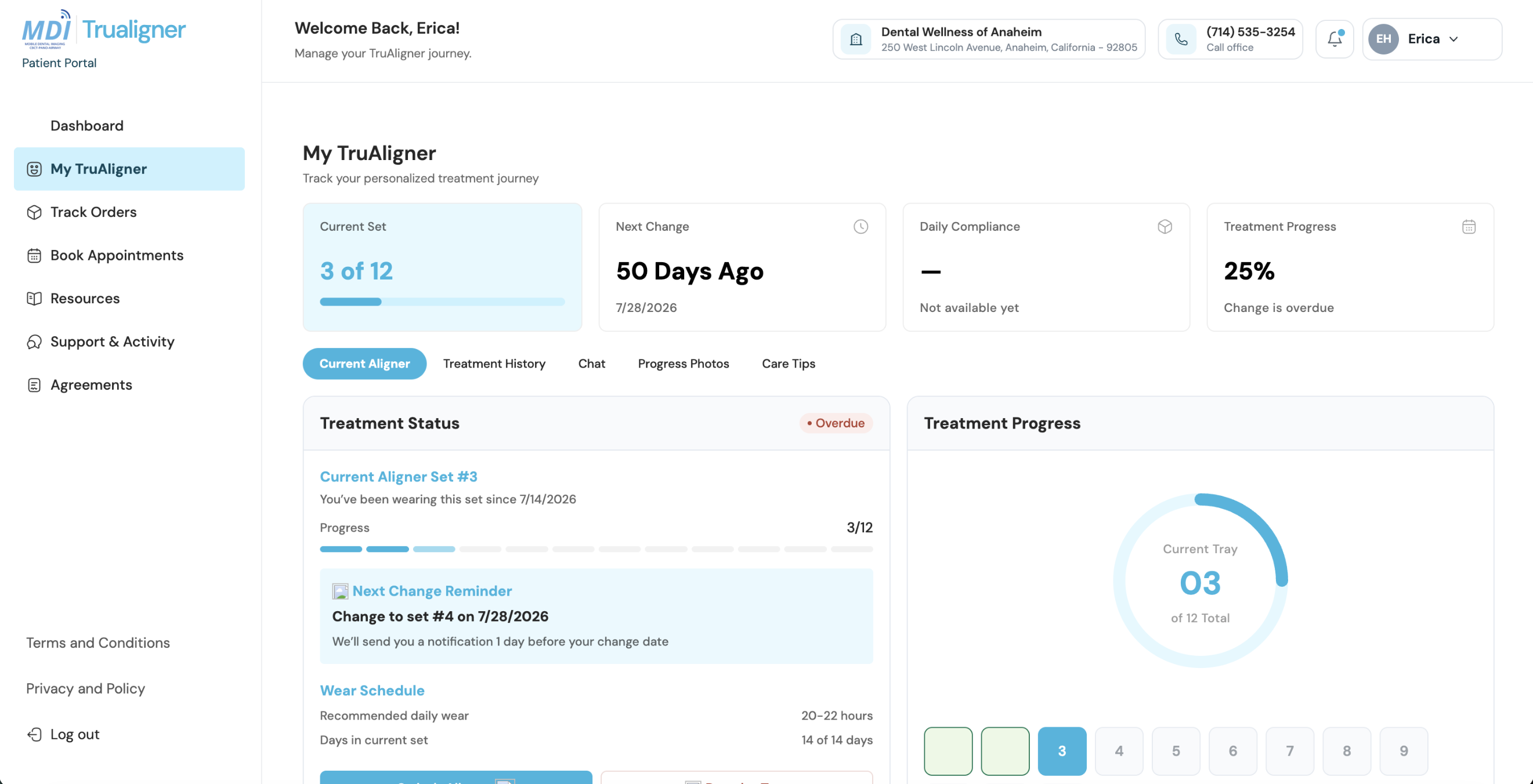
When treatment starts you get a portal of your own. It holds the tray you are on, the date you change it, your appointments, your forms and the dentist responsible for your care.
What we treat
Even a small misalignment changes how your teeth meet, and that shows up over years as uneven wear, strain and cleaning that never quite works. If any of these look familiar, it is worth having a licensed dentist take a look.
Too many teeth in too little space.
Crowding happens when the jaw has not got room for every tooth, so they overlap or twist out of line. Overlapped surfaces are hard to reach with a brush or floss, and plaque left there is what starts decay and gum inflammation.
Gaps between several teeth.
Gaps let food pack against the gum between the teeth, and gum that is repeatedly irritated tends to recede. Spacing also changes how the front teeth share the load when you bite.
Upper teeth overlap too far over the lower.
When the upper front teeth cover the lower ones too far, the lower edges grind against the back of the uppers each time you close. Over years that wears enamel off both, and a deep bite can leave the jaw joint working harder than it should.
Lower teeth sit in front of the upper.
With the lower teeth closing in front of the uppers, chewing loads the front teeth rather than the molars built for it. The edges chip, and the jaw is held forward of its natural resting position.
An upper tooth closes inside the lower.
A tooth that closes on the wrong side of its opposite wears on one side only, and the jaw often shifts sideways to find a comfortable bite. Left alone, that shift can become the position the jaw settles into.
Front teeth do not meet when closed.
When the front teeth never meet, everything you bite through is handled by the back teeth alone, which wears them faster. Some sounds are also harder to form without the front teeth making contact.
Some teeth have the potential to be straighter.
Not every case is a named bite problem. Teeth that are only slightly out of line still wear unevenly and collect plaque where they overlap, and they are usually the quickest cases to treat.
Not enough space for permanent teeth to come in safely.
While baby teeth are still being lost, the permanent ones underneath need room to come through in line. Where the arch is short of space they erupt rotated or blocked out, and guiding that early is far simpler than correcting it later.
Not sure which one sounds like you?
Get StartedWhy it matters
With TruAligner, your treatment is guided by your doctor and supported by advanced technology—helping you achieve a straighter smile and long-term oral health.
Most treatments run four to twelve months, with aligners worn 20 to 22 hours a day. Every case is reviewed by a licensed dentist before it begins.

How it works
From your first scan to the day your aligners arrive.
Get Started
We come to you
Schedule an appointment though Mobile Dental Imaging, a service that will come to you and scan your teeth at your location, or Get a scan in-office or through a trusted provider
Book an MDI Service Appointment
A dentist plans it
Your treatment is reviewed and guided by a licensed dentist who oversees every step of your care—ensuring safe, precise, and personalized results.

Made for your teeth
Custom-designed for your teeth and your goals

A Mobile Dental Imaging technician meets you at the address you give when you book, at home or at work, and takes the 3D scan there. No dental office to get to, and nothing to pay on the day.
Book your scanWhat treatment changes
 Before
 After
After

Crowding, corrected.
Crowded teeth are brought into line across a series of trays, each one shaped for a single stage of the plan. Most treatments run four to twelve months, with aligners worn 20 to 22 hours a day.
Illustration of a typical crowding case. Individual results vary and are determined by your dentist.
Recommended
22 hrs
hours per day
Minimum
20 hrs
hours per day
Dentist-reviewed
Every case
22h
Every case is reviewed and directed by a licensed dentist
3/5
Treatment is directed by the dentist who knows your mouth, made to a plan built for your teeth, and checked as your smile moves.
Get StartedQuestions, answered
Everything patients ask us most, answered by the team that plans your treatment.